Embracing the Digital Age in Dentistry
Modern dental practices rely on digital imaging tools that replace messy impressions and static X‑rays. Intra‑oral scanners like iTero capture high‑resolution 3‑D models of a patient’s dentition in minutes, while cone‑beam CT (CBCT) provides volumetric data of bone, teeth, and soft tissue. These technologies give clinicians a complete anatomical map, improve diagnostic accuracy, and enable precise virtual treatment planning.
The benefits of intra‑oral scanning and CBCT are immediate: patients experience a comfortable, gag‑free impression process, and the digital data can be sent instantly to design software. Accurate scans reduce material waste, shorten chair time, and allow same‑day or next‑day fabrication of crowns, bridges, and aligners.
When combined with CAD/CAM, the workflow becomes seamless. Scans are imported into CAD programs, restorations are designed, and the files are sent directly to in‑office 3‑D printers or milling units. This integration delivers a marginal fit that meets accuracy, lowers lab fees, and supports personalized care.
Understanding the Digital Workflow at V Dental
Digital Workflow at V Dental
| Step | Tool / Technology | Purpose |
|---|---|---|
| 1 | iTero intra‑oral scanner | Capture high‑resolution 3‑D dentition model |
| 2 | CBCT 3‑D imaging | Add volumetric bone & soft‑tissue data |
| 3 | CAD software (e.g., exocad) | Virtual treatment planning & design of crowns, veneers, aligners, guides |
| 4 | In‑office 3‑D printer (SLA/DLP) | Print biocompatible resin or ceramic‑filled restoration |
| 5 | Post‑processing (wash, cure, polish) | Achieve final anatomy, shade, and intra‑oral safety |
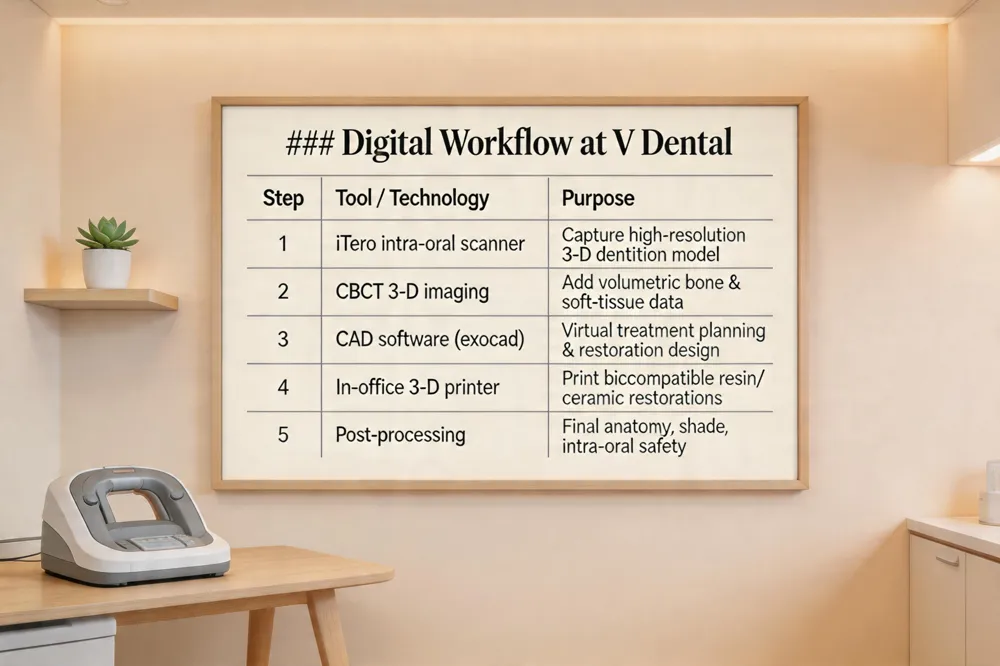 V Dental’s digital workflow begins with iTero intra‑oral scanning, which captures a high‑resolution, 3‑D model of the patient’s dentition in minutes, eliminating the mess of traditional impressions. CBCT 3‑D imaging then adds volumetric data of bone and soft tissues, giving clinicians a comprehensive view for implant planning or orthodontic case analysis. The combined scan data is imported into CAD software, where virtual treatment planning creates precise designs for crowns, veneers, clear aligners, and surgical guides. Once the digital design is approved, it drives the in‑office 3‑D printer; the printer layers biocompatible resin or ceramic‑filled material to produce a final restoration that matches the patient’s anatomy and shade.
Digital dentistry articles – V Dental’s blog regularly publishes articles that explore the latest developments in digital dentistry, covering CBCT imaging, iTero scanning, CAD‑CAM, 3‑D printing, and AI‑driven analysis, all written in plain language for patients.
Benefits of digital dentistry – The workflow provides accurate 3‑D images, faster diagnoses, personalized treatment plans, reduced chair‑time, same‑day crown or aligner placement, early detection of decay or bone loss, and higher predictability, enhancing comfort and outcomes for families in Live Oak and surrounding communities.
3D‑Printed Crowns: Materials, Strength, and Longevity
3D‑Printed Crown Materials Overview
| Material | Typical Use | Flexural Strength (MPa) | Expected Longevity (years) | Notes |
|---|---|---|---|---|
| Ceramic‑filled resin (e.g., SprintRay Crown) | Temporary / low‑load restorations | 90‑150 (average) / up to 1900 N breaking load | 5‑10 (temporary) | Fast printing, 7‑shade color match |
| Zirconia (milled) | Permanent posterior crowns | >500 | 10‑15+ | Superior durability & wear resistance |
| Lithium disilicate (milled) | Permanent anterior esthetic crowns | >500 | 10‑15+ | High translucency, strong |
| 3D‑printed zirconia (lithography‑based) | Emerging permanent crowns | Clinically acceptable marginal gaps (≈130 µm) | Early adoption | Not yet widely available |
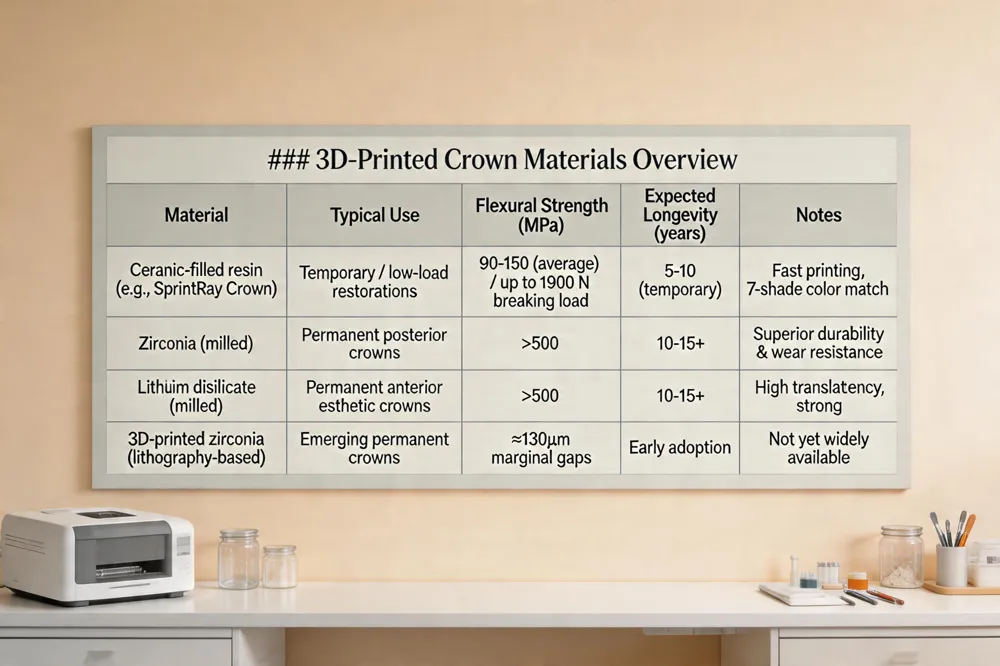 Ceramic‑filled resin crowns dominate today’s chair‑side 3D‑printing because the resin‑based composite can be printed quickly, color‑matched in seven shades, and provides a marginal fit comparable to milled zirconia (RMS deviation ≈130 µm). However, its flexural strength is lower than that of zirconia or lithium disilicate, so it is best suited for temporary or low‑load restorations. Mechanical testing of FDA‑cleared SprintRay Crown resin shows a breaking load of 1 936 N, exceeding many competitor resins, while newer high‑performance dental resins can sustain 10–15 years in service. Zirconia and lithium disilicate remain the gold standard for permanent crowns; they are milled in‑house at V Dental, offering superior durability and wear resistance. 3D‑printed zirconia crowns are emerging via lithography‑based ceramic manufacturing, achieving clinically acceptable marginal gaps, but are not yet widely available. In practice, resin crowns are typically temporary (5–10 years) whereas milled zirconia or lithium disilicate crowns can last 10–15 years or more with proper care.
Aligner Technology: From Scans to Treatment
Aligner Workflow Summary
| Platform | Scan Method | Lab Process | Typical Turnaround | Key Clinical Rule |
|---|---|---|---|---|
| Invisalign® | iTero intra‑oral scan | STL sent to authorized Invisalign lab → thermo‑formed FDA‑cleared polymer aligners | 1‑2 weeks (lab) | 30‑minute rule – re‑insert aligner within 30 min after removal |
| Direct 3D‑printed aligners (emerging) | iTero or other scanner | In‑office SLA/DLP printer → post‑cure → final polishing | Same‑day to 2‑3 days | Requires validated biocompatible resin & regulatory clearance |
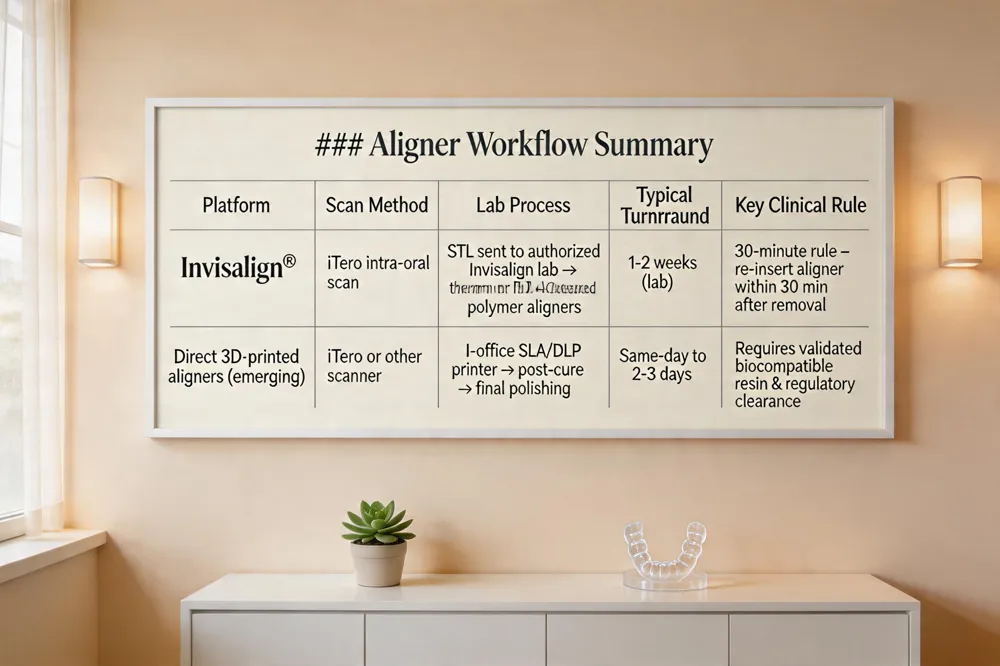 The Invisalign® platform uses a patented digital workflow that begins with an iTero intra‑oral scan, replaces traditional impressions, and feeds a 3‑D model into ClinCheck® software. ClinCheck lets clinicians map every tooth movement, customize forces, and preview the final smile before any appliance is made. For most patients V Dental relies on this proven system; the practice does not provide a direct online service for 3‑D‑printing custom aligners, nor does it produce its own printed trays in‑office. Instead, the digital scan is sent to an authorized Invisalign laboratory where FDA‑cleared polymer resins are thermo‑formed into aligners. Some labs and newer practices use 3‑D‑printed dental models (e.g., SprintRay, Formlabs, LuxCreo) to thermo‑form aligners or, in emerging workflows, print the aligners directly from biocompatible resin. While direct 3‑D‑printed aligners can reduce turnaround, V Dental prefers the reliability and safety of the Invisalign system. The 30‑minute rule—re‑inserting aligners within 30 minutes after removal—maintains consistent orthodontic force and protects oral health.
In‑Office 3D Printing: Capabilities and Limitations
In‑Office 3D Printing Capabilities
| Printer Type | Materials Supported | Post‑Processing Steps | Regulatory Standards |
|---|---|---|---|
| SLA / DLP (e.g., SprintRay, Formlabs, LuxCreo) | Biocompatible resins, ceramic‑filled hybrid resins, FDA‑cleared polymers | IPA wash → UV/heat cure → support removal → polishing/glazing | Class II medical device, ISO 10993 intra intra‑oral safety |
| Lithography‑based ceramic (emerging) | Zirconia slurry | Wash → debind → sinter → glaze | Still under FDA/CE clearance for permanent use |
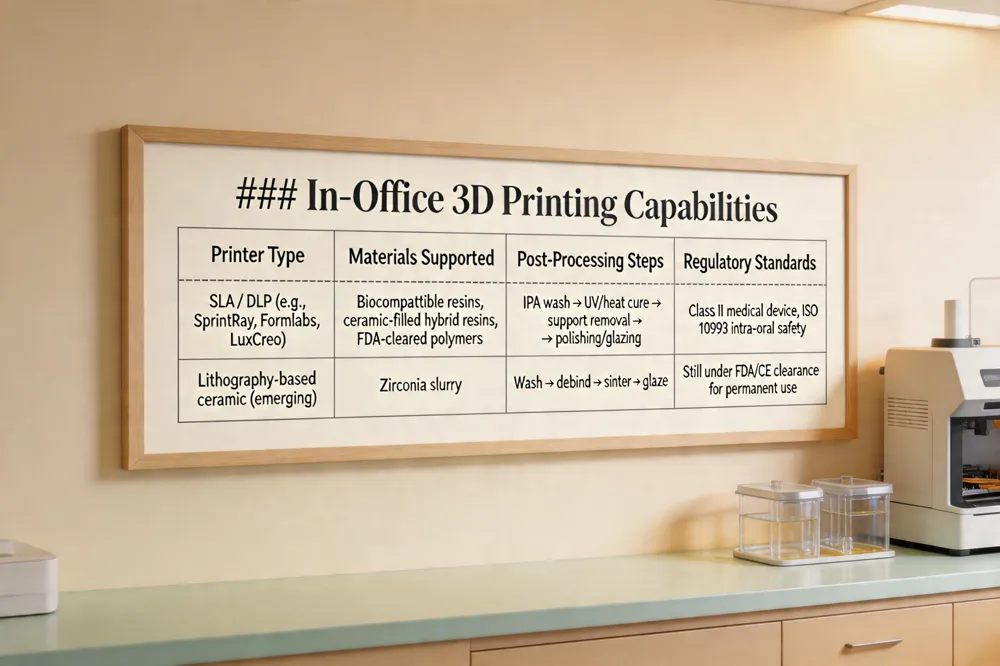 Desktop SLA/DLP printers such as SprintRay, Formlabs and LuxCreo have made in‑office additive manufacturing practical for most dental practices. The workflow begins with a high‑resolution intra‑oral scan (iTero, 3Shape, etc.) that generates an STL file, which is imported into CAD software, designed for the required appliance, and sliced for the printer. After printing, the part undergoes post‑processing steps: IPA washing, UV or heat curing, support removal and final polishing or glazing to achieve a smooth, biocompatible surface. All materials used—biocompatible resins, ceramic‑filled hybrid resins, or FDA‑cleared polymers—must meet Class II medical‑device regulations and ISO 10993 standards for intra‑oral safety, and clinicians 3D print teeth aligners? Yes, 3D‑printing can produce custom clear aligner trays directly from the digital design, allowing orthodontists to fabricate precise, patient‑specific aligners quickly and accurately, often in a single day.
Patient Considerations: Cost, Financing, and Safety
Patient Financial & Safety Overview
| Factor | Details |
|---|---|
| Invisline Cost** | $3,000 – $7,000 depending on case complexity |
| Typical Comprehensive Treatment | ≈ $6,000 (includes 3‑D imaging, aligners, retainers, check‑ups) |
| Financing Options | 0 % interest plans, monthly installments, 12‑24 month care‑free payments |
| Insurance | Most carriers cover portion of orthodontic fees with medical‑necessary justification |
| Safety | All appliances made from FDA‑cleared, ISO 10993‑compliant resins; biocompatible for intra‑oral use |
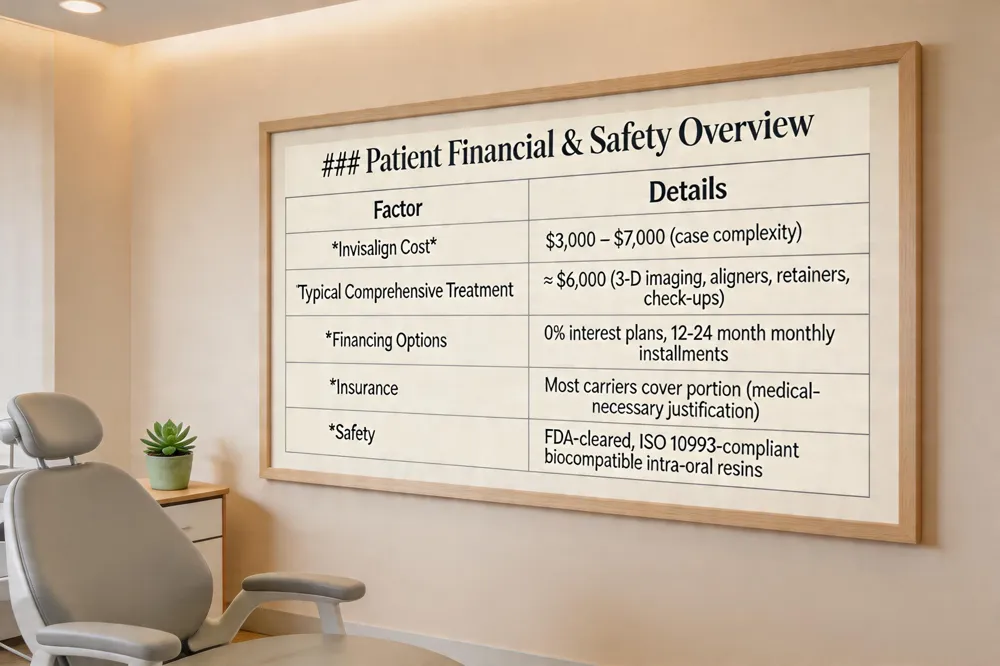 Invisalign pricing in the United States typically ranges from $3,000 to $7,000, depending on case complexity, number of trays, and regional cost of living. A $6,000 bill is therefore normal for a comprehensive treatment that includes 3‑D imaging, the full set of aligners, retainers and periodic check‑ups. V Dental in Live Oak, Texas offers flexible financing such as 0 % interest plans, monthly installments, and care‑free payment options that let patients spread the cost over 12 to 24 months. The practice also works with most dental insurance carriers; many policies cover a portion of orthodontic fees when a medical‑necessary justification is provided, and the remaining balance can be handled through the office’s financing program. All 3‑D‑printed appliances at V Dental are made from FDA‑cleared, biocompatible resins that meet ISO 10993 standards, ensuring safe intra‑oral use. Patients can request a detailed cost estimate and explore insurance benefits before starting treatment.
Clinical Decision‑Making: Choosing the Right Restoration
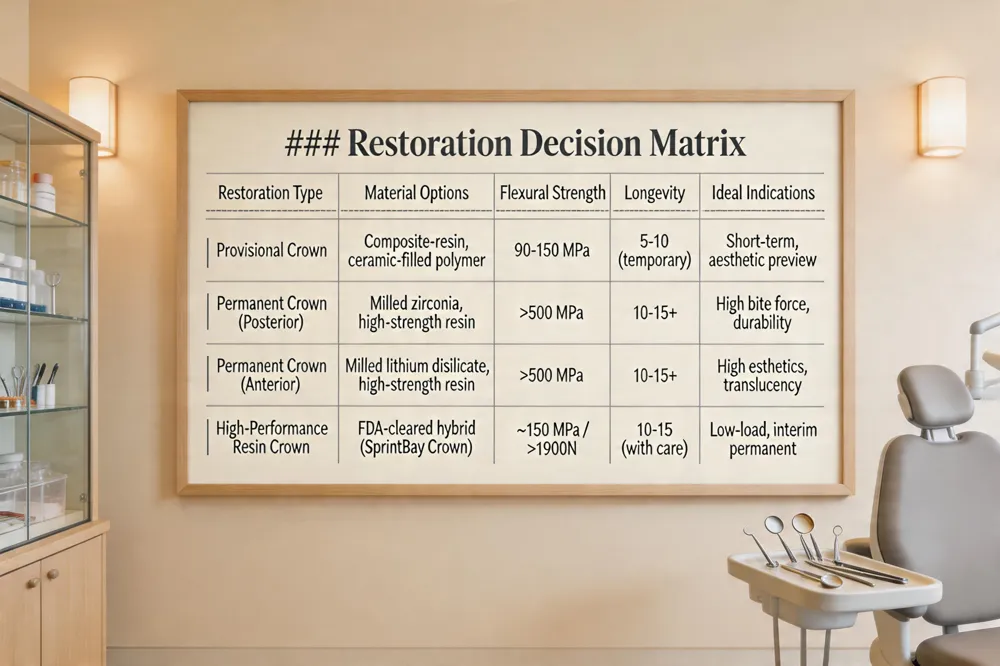
Restoration Decision Matrix
| Restoration Type | Material Options | Flexural Strength (MPa) | Longevity (years) | Ideal Indications |
|---|---|---|---|---|
| Provisional Crown | Composite‑resin, ceramic‑filled polymer | 90‑150 | 5‑10 (temporary) | Short‑term, aesthetic preview |
| Permanent Crown (Posterior) | Milled zirconia, high‑strength resin | >500 | 10‑15+ | High bite force, durability needed |
| Permanent Crown (Anterior) | Milled lithium disilicate, high‑strength resin | >500 | 10‑15+ | High esthetics, translucency |
| High‑Performance Resin Crown | FDA‑cleared hybrid resin (SprintRay Crown) | ~150 (flexural) / >1900 N breaking load | 10‑15 (with care) | Low‑load, interim permanent solution |
 Temporary vs. Permanent Crowns
In‑office 3D printing quickly creates provisional crowns from composite‑resin or ceramic‑filled polymers that are biocompatible but have lower flexural strength than long‑term materials. Permanent crowns use higher‑strength resins, zirconia, or lithium disilicate for lasting occlusal load.
Strength and Durability of Printed vs. Milled Materials
Milled zirconia or glass‑ceramic restorations usually exceed 500 MPa flexural strength and show superior wear resistance, whereas most 3D‑printed resins range 90‑150 MPa. FDA‑cleared hybrid resins (e.g., SprintRay Crown) achieve breaking loads >1900 N, narrowing the gap for short‑term use.
Regulatory Clearance and Material Validation
Only FDA 510(k) or CE‑Mark‑cleared materials may be placed permanently. Clinics must confirm printer‑file workflow, post‑curing protocol, and long‑term aging data meet manufacturer specifications.
Patient‑Specific Factors Influencing Material Choice
Bone quality, bite force, aesthetic demand, allergy history, and budget guide selection. Masticatory loads or posterior restorations favor milled zirconia; esthetic anterior cases or quick needs can be met with 3D‑printed resin crowns.
Future Directions: Bioprinting, AI, and Sustainable Practices
Emerging Trends in Digital Dentistry
| Innovation | Potential Impact | Current Status |
|---|---|---|
| Bioprinting & bio‑active resins | Bond to tooth structure, release therapeutic ions, support tissue regeneration | Research & early clinical trials |
| AI‑driven treatment planning | Optimize aligner thickness, force vectors, crown geometry; predictive outcomes | Integrated in some CAD platforms, expanding |
| Sustainable manufacturing | Closed‑loop resin recycling, waste reduction, lower carbon footprint | Pilot programs in select labs, growing adoption |
| Same‑day digital smile design | Scan → AI design → on‑site printing of permanent restorations & aligners in one appointment | Conceptual, limited early‑stage implementations |
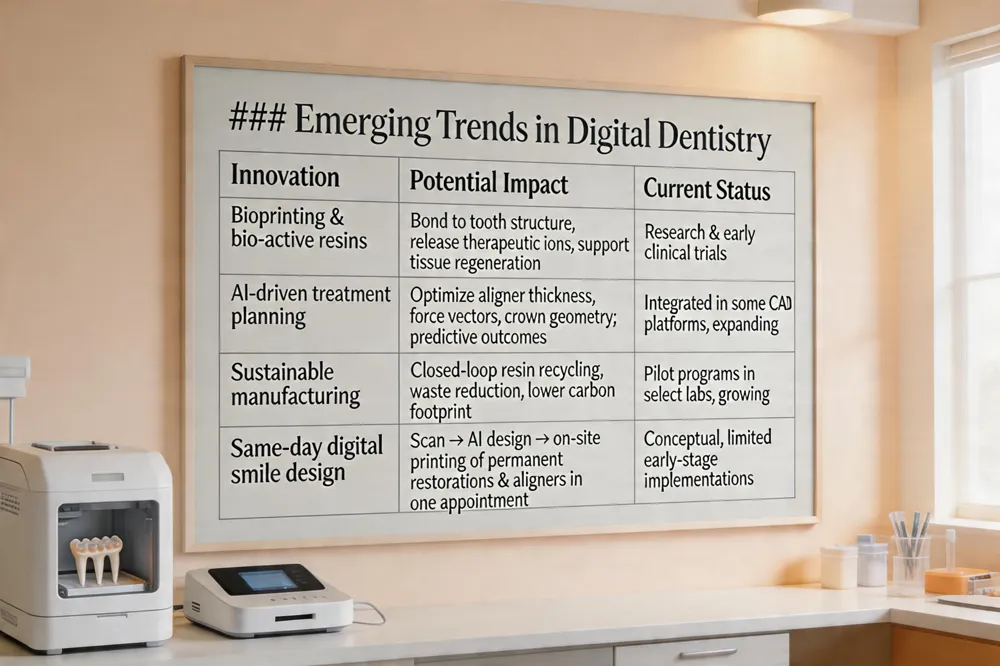 The next wave of dental 3D printing will hinge on new biocompatible and bio‑active resins that can bond to tooth structure, release therapeutic ions, and even support tissue regeneration, moving beyond current composite or ceramic‑filled polymers. AI‑driven treatment planning is already reshaping workflows—integrating intra‑oral scans, CBCT data, and predictive models to optimize aligner thickness, force vectors, and crown geometry for faster, more precise outcomes. Sustainable manufacturing is becoming a priority: additive processes waste only the material needed, and emerging recycling loops for resin and support structures further cut landfill impact, aligning with environmentally conscious practices. Together, these advances promise a fully digital, same‑day smile design platform where a patient’s scan drives AI‑generated designs that are printed on‑site in biocompatible, bio‑active materials, delivering permanent restorations and orthodontic appliances in a single appointment.
The Promise of Faster, Customized Dental Care
At V Dental in Live Oak, Texas, every patient visit begins with an iTero intra‑oral scan that feeds directly into CAD software and a 3‑D printer. The digital workflow eliminates traditional impressions, allowing the practice to design crowns, bridges, retainers and clear aligners in minutes. When a crown is indicated, the design is printed on a SprintRay or Formlabs machine, post‑cured, polished and bonded in the same appointment, giving patients a restoration without a provisional phase. Aligners are generated from a series of printed models or, in some cases, printed directly, enabling delivery of the first tray. Patients enjoy faster treatment, fewer office visits, fit and lower cost because lab fees and adjustment appointments are minimized. V Dental’s adoption of these technologies follows a strict evidence‑based protocol: only FDA‑cleared, validated materials are used, and each case is reviewed for long‑term oral health outcomes, ensuring that speed never compromises safety or quality.