Why Cost Matters When Choosing a Smile Solution
When deciding between dentures and dental implants, the upfront price is often the first factor patients notice. A conventional full denture set typically costs between $1,000 and $3,000 per arch in the United States, while a single‑tooth implant averages $3,000‑$5,000 (including the post, abutment, and crown). Full‑arch implant solutions, such as All‑on‑4, can range from $15,000 to $30,000 per arch, reflecting the surgical component and multiple titanium posts required.
Long‑term maintenance also diverges sharply. Dentures generally need replacement or major relining every five to seven years, with each adjustment costing $300‑$800 and adhesives adding $30‑$50 per month. Over a decade, total denture expenses can exceed $10,000. Implants, by contrast, are designed to last a lifetime with proper oral hygiene; routine cleanings cost $100‑$200 per visit, and the cumulative maintenance for a ten‑year period is typically $1,000‑$2,000.
Beyond cost, bone health and oral function are critical. Traditional dentures sit on the gums and do not stimulate the jawbone, often leading to bone resorption and changes in facial structure. Implants act as artificial roots, preserving bone density and maintaining facial support. Functionally, implants restore 85‑90% of normal chewing efficiency, whereas dentures achieve only about 30%.
Financing options bridge the gap between upfront expense and long‑term value. Programs such as CareCredit, BNPL services, HSAs/FSAs, in‑house payment plans, and third‑party lenders allow patients to spread implant costs over 12‑36 months, many with 0% promotional APR. Denture patients can also benefit from low‑interest plans, making high‑quality, bone‑preserving solutions attainable for a broader range of budgets.
Dental Cost Comparison Key Facts
- A single‑tooth dental implant in the U.S. typically costs between $3,000 and $6,000 (national average $2,143‑$4,175).
- A conventional full denture costs $1,000‑$3,000 per arch, with many patients paying around $1,800‑$2,000 for a complete set.
- Over a ten‑year horizon, total denture expenses—including relines, replacements, and adhesives—can reach $6,000‑$17,500.
- Implant survival rates exceed 95% over ten years, with many prostheses lasting 20‑30 years or longer.
- Snap‑in (implant‑supported) dentures average $2,480 per arch (range $1,901‑$4,729).
- All‑on‑4 full‑arch implant solutions are priced $15,000‑$30,000 per arch depending on materials and adjunctive procedures.
- Extractions add $75‑$800 per tooth, and bone‑grafting or sinus‑lift procedures add $500‑$3,000 per site.
- Implant‑supported dentures typically require less than $2,000 in maintenance costs over ten years.
- Financing options include 0% APR CareCredit plans, HSA/FSA accounts, and limited coverage through Medicare Advantage plans.
- 3‑D‑printed dentures, using CAD/CAM and intra‑oral scanners, offer rapid, precise, and custom‑fit prostheses and are considered the most advanced denture technology today.
1. Overall Cost Comparison: Implants vs. Traditional Dentures
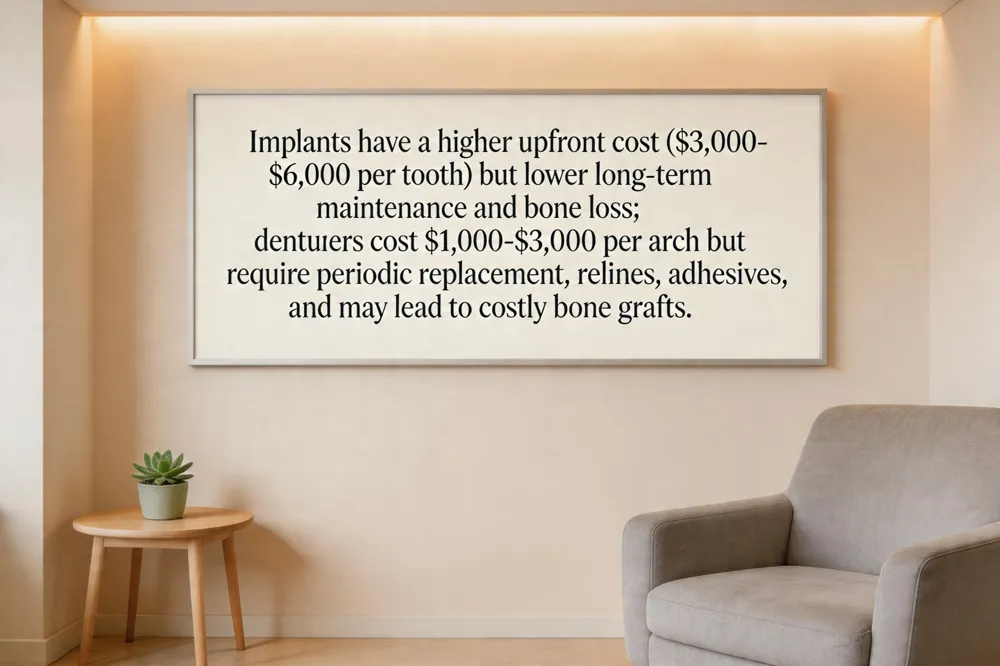 When patients first evaluate options for replacing missing teeth, the most obvious difference is the upfront price. A single‑tooth dental implant in the United States typically costs between $3,000 and $6,000, with national averages ranging from $2,143 to $4,175 depending on the study source (CareCredit, Aspen Dental, and various regional surveys). In contrast, a complete set of conventional removable dentures is far less expensive, averaging $1,000 to $3,000 per arch (CareCredit, Dental Implant Cost and Procedure Guide) and often quoted as $1,000 for a full set in many national surveys.
The long‑term economics shift dramatically after placement. Traditional dentures generally require replacement every five to seven years because the gums and underlying bone change shape; some reports extend the cycle to ten years for premium dentures. Each replacement brings a new expense of $1,500–$3,500 and may include additional relining or adjustment fees of $300–$800. Moreover, denture wearers incur recurring costs for daily adhesives ($30–$50 per month) and periodic cleaning solutions.
Dental implants, while demanding a higher initial investment, are designed to last a lifetime with proper oral hygiene. Clinical data show implant survival rates of 95%+ over ten years and many patients retain their prostheses for 20–30 years or more. A key financial advantage is the bone‑preserving effect of osseointegration; implants stimulate the jawbone, preventing the resorption that commonly follows long‑term denture use. By preserving bone density, implants reduce the likelihood of future surgical interventions such as bone grafts, which can add $500–$3,000 to treatment costs.
In summary, dentures offer a low‑cost entry point but generate hidden recurring expenses—adhesives, relines, periodic replacements—and may lead to costly bone loss over time. Implants require a larger upfront outlay but provide permanent, bone‑stimulating support that can offset long‑term maintenance and health‑care costs, making them a more cost‑effective solution for many patients when viewed over a 10‑ to 20‑year horizon.
2. Targeted Cost Scenarios: Seniors, Snap‑On vs. All‑on‑4, and Full‑Mouth Restorations
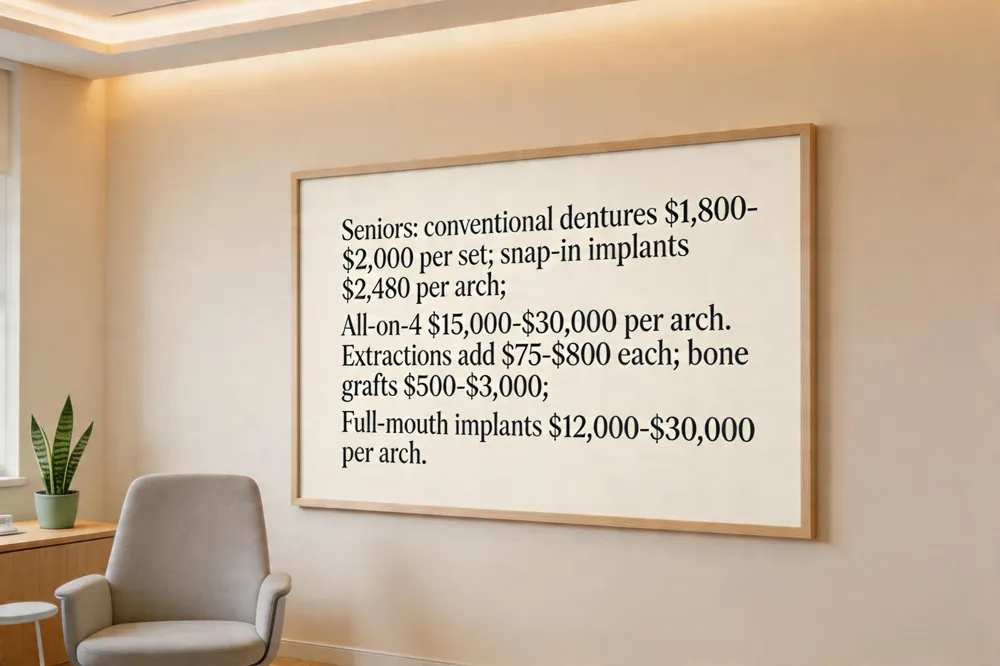 When seniors evaluate their options, the price gap between conventional dentures and implant‑supported solutions is striking. A full set of traditional removable dentures typically runs $1,000–$3,000 per arch, with many patients paying around $1,800–$2,000 for a complete upper‑and‑lower set. In contrast, implant‑supported dentures (often called snap‑in or overdentures) cost considerably more because they require surgical placement of titanium posts. Snap‑in dentures average $2,480 per arch (range $1,901–$4,729), while the more extensive All‑on‑4 full‑arch implant solution is priced $15,000–$30,000 per arch, depending on material, lab fees and any adjunctive procedures.
If extractions are needed before denture fabrication, the total expense rises. Conventional full dentures still cost $1,500–$5,000, but each extraction can add $75–$800, and bone‑grafting or sinus‑lift procedures—often required for implant cases—add another $500–$3,000 per site. Thus, a senior who needs several extractions may see the overall denture cost climb into the $2,500–$4,000 range, while the implant route could exceed $20,000 once surgical and restorative fees are included.
Full‑mouth implant restorations have the widest price range. A single‑tooth implant averages $2,143–$4,143 (including crown), but a complete arch using All‑on‑4 or All‑on‑6 can cost $12,000–$30,000 per arch. Factors that push the final price higher include the number of implants required (more implants for better support), the type of prosthetic material (zirconia crowns and premium acrylic vs. basic titanium), the need for bone augmentation (grafts, sinus lifts), geographic location (urban vs. rural), and the provider’s experience. Financing tools such as CareCredit or in‑house payment plans help spread these large upfront costs, but patients should weigh the long‑term benefits—bone preservation, reduced maintenance, and a lifespan that can exceed 20 years—against the higher initial investment.
Comparing Treatment Options
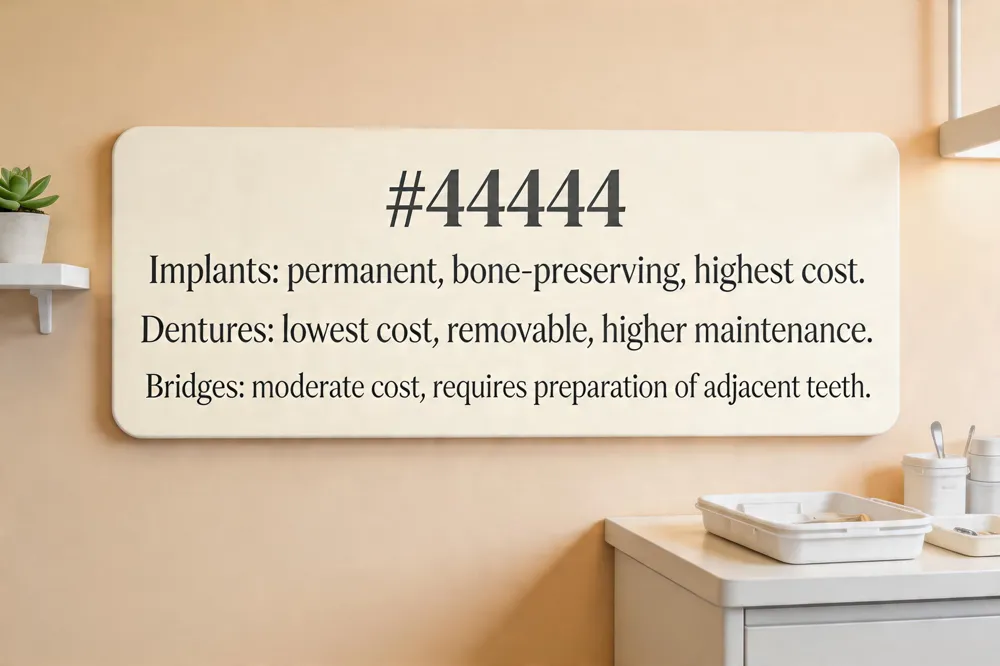 When deciding between a denture, a bridge, or an implant, it’s essential to match the treatment to the patient’s clinical situation and budget. Implant vs. denture vs. bridge – Dental implants act as artificial roots surgically placed into the jawbone, offering a permanent, bone‑preserving solution that feels and functions like a natural tooth. Dentures are removable prostheses that replace a full arch or a partial set of teeth; they are the least invasive and most affordable option but can slip, cause sore gums, and do not stimulate bone growth. A dental bridge fills a short gap by anchoring a false tooth (or multiple teeth) to the crowns of adjacent healthy teeth, requiring preparation of those teeth and offering a middle‑ground cost and stability. Implants generally deliver the most natural look, long‑term value, and comfort, while dentures are best when many teeth are missing and surgery is not desired, and bridges work well for a few consecutive missing teeth when the neighboring teeth are strong enough. Choosing among them depends on the number of missing teeth, budget, oral‑health status, and how important permanence and bone preservation are to the patient. What is the most expensive type of dentures? – Implant‑supported dentures are the cost expensive. They require surgical placement of titanium posts, advanced digital imaging, and custom‑fabricated prosthetic teeth, pushing total costs well above conventional full, partial, or temporary dentures. Snap‑on dentures vs. All‑on‑4 cost – Snap‑on (implant‑supported) dentures typically run $8,000‑$20,000 per arch, covering implants, a removable acrylic base, and attachment hardware. All‑on‑4 full‑arch solutions are higher, ranging from $18,000‑$40,000 per arch, because they use a fixed bridge supported by four strategically placed implants and often employ premium materials. Which dentures are most affordable? – The most affordable option is a basic, removable full denture, sometimes called an economy denture, which averages about $452 per arch (range $348‑$883). Standard full dentures average $1,968, while partial or metal‑based dentures can cost $1,700‑$2,300 or more.
Cost Considerations for Seniors and Full‑Mouth Treatments
 When seniors evaluate options for replacing missing teeth, price is a major factor, but long‑term durability and maintenance also matter.
Dentures vs implants for elderly – price comparison
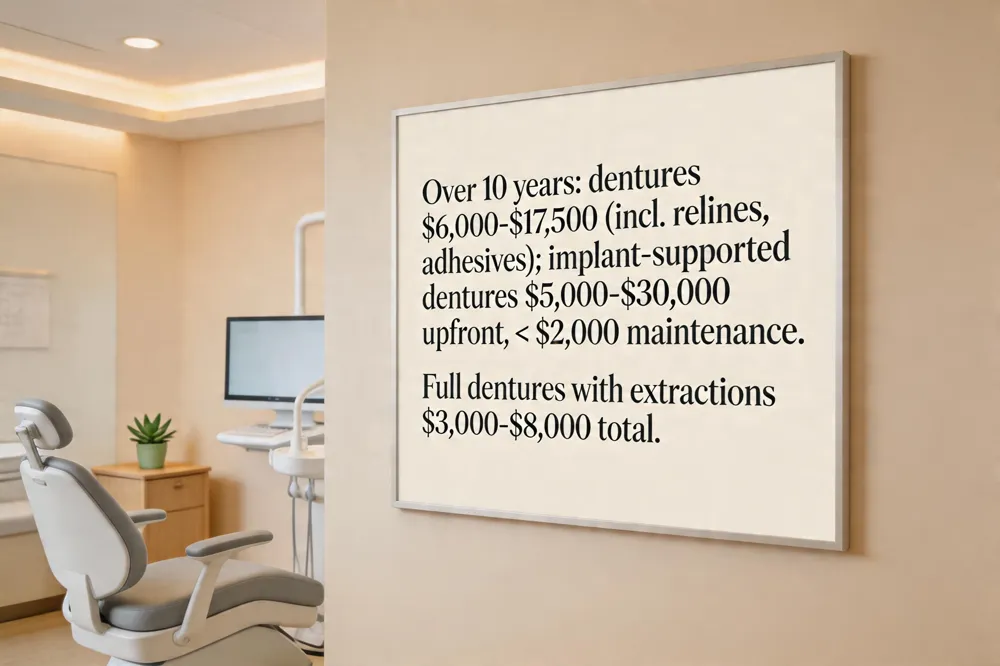
Traditional full dentures usually start at $1,200‑$3,500 per set. They require periodic relines or replacements every 5‑7 years, adding $1,000‑$2,500 each time. Over ten years, total denture costs—including adjustments, adhesives, and replacements—can reach $6,000‑$17,500. Implant‑supported dentures cost considerably more upfront, typically $5,000‑$30,000 depending on the number of implants and design (bar‑retained or All‑on‑4). However, implants often last 20 years or more with minimal upkeep, and ten‑year maintenance usually stays under $2,000.
Cost of full dentures with extractions
Full removable dentures after extractions range from $1,200‑$3,500 per arch. Each tooth extraction adds $75‑$300 for a simple removal or $200‑$600 for a surgical extraction. When both arches are needed, the combined denture cost falls into the $2,400‑$7,000 range, and total expenses—including extractions—typically lie between $3,000 and $8,000. Immediate dentures placed right after extractions are slightly higher, often $1,500‑$4,000 per arch, because they are fabricated and fitted quickly.
How much does a full set of dentures cost in the US?
On average, a traditional full‑arch denture in the United States costs roughly $1,800. Low‑cost cold‑cured acrylic sets run about $600‑$1,000 for the complete set, mid‑range heat‑cured dentures fall between $1,000 and $3,000, and premium custom dentures using high‑quality materials or digital design can cost $4,000‑$8,000 or more.
Financing, Insurance, and Payment Options
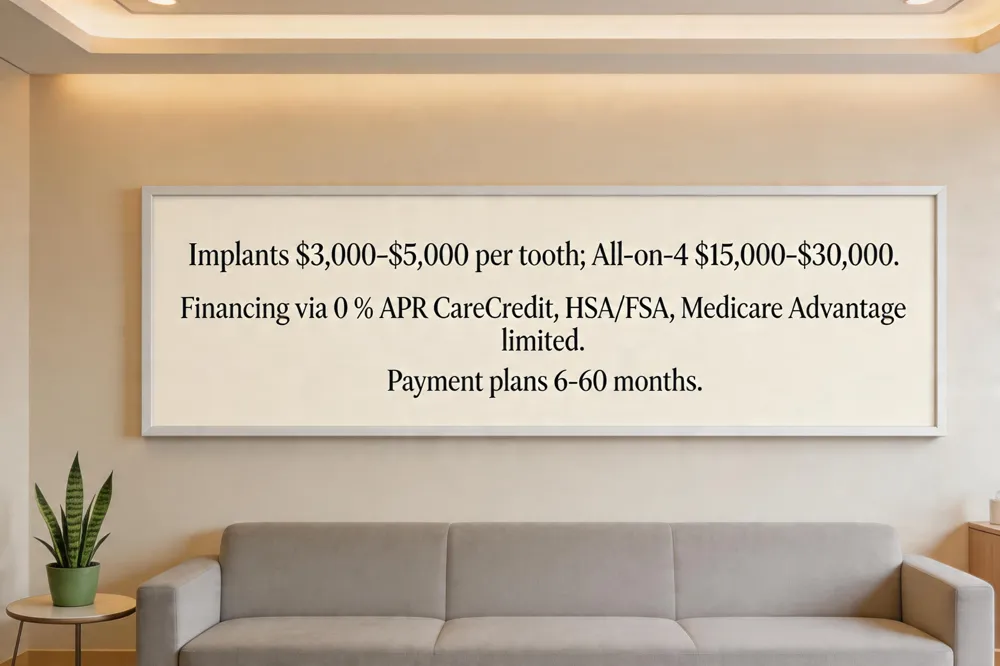 Choosing between dentures and dental implants is not only a clinical decision but also a financial one. Implants typically cost $3,000–$5,000 per tooth (or $15,000–$30,000 for a full‑arch All‑on‑4 solution), while a conventional full denture can be $1,000–$3,000. The higher upfront price of implants can be managed through several payment pathways.
Payment installments for implants – V Dental partners with lenders that offer 0 % APR or low‑interest plans spread over 6 to 60 months, allowing patients to begin treatment without paying the entire bill at once. Third‑party medical credit cards such as CareCredit provide promotional interest‑free periods, and buy‑now‑pay‑later services can add qualified borrowers short‑term, 0 % financing.
Medicare coverage for implants – Original Medicare (Parts A and B) does not cover routine dental care or implants. Only Medicare Advantage (Part C) plans may include limited dental benefits, and even then high‑cost elective procedures like implants are rarely covered. Patients should verify any supplemental dental benefits before assuming coverage.
Best ways to finance implants – The most tax‑efficient strategy is to use an HSA or FSA, which lets you pay with pre‑tax dollars. After exhausting those accounts, look for 0 % APR financing or short‑term payment plans offered by V Dental’s partner lenders. CareCredit’s 6‑ or 12‑month promotional periods are popular for multi‑tooth cases. In‑house payment plans and third‑party medical loans (e.g., Proceed Finance, OneMain) are also available for patients with varying credit profiles.
Patient expectations before implant treatment – Implant therapy is a multi‑step process that can take three to nine months from consultation to final crown, including surgical placement, healing, and restoration. Bone health is critical; insufficient bone may require grafting, adding $500–$3,000 to the cost. While daily maintenance is simple—regular brushing, flossing, and routine check‑ups—consistency is essential for long‑term success. Understanding the timeline, potential preparatory procedures, and financing options up front helps set realistic expectations and makes the investment more manageable.
Clinical Concerns and Advanced Options
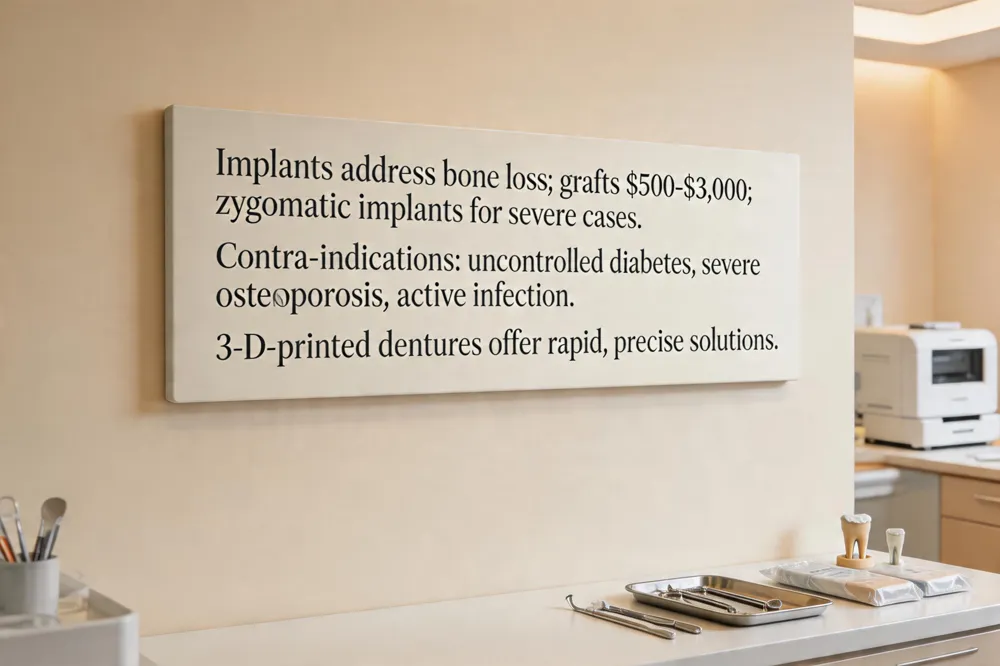 Implants for jaw bone loss remain the gold‑standard solution for patients experiencing resorption. Titanium posts stimulate the alveolar bone, preserving density and even rebuilding lost tissue through osseointegration. When native bone is insufficient, grafting procedures—often costing $500‑$3,000—can regenerate the area, and in extreme upper‑jaw cases zygomatic implants anchor into the cheekbone, bypassing the deficient jaw entirely. Implant‑supported overdentures also restore a stable bite while continuing the bone‑preserving stimulus.
Dentalure cost comparison near you (Texas) shows a full set of conventional removable dentures ranging from $1,200 to $3,500, while partial dentures fall between $800 and $2,200. Acrylic models sit at the lower end, porcelain or premium custom‑crafted options push prices higher. Practices that employ digital impressions and CBCT 3‑D imaging—such as V Dental in Live Oak—often reduce lab fees and appointment time, yielding modest savings.
Why a dentist may not recommend an implant: active infections, untreated periodontal disease, poor oral hygiene, uncontrolled diabetes, severe osteoporosis, immunosuppressive conditions, heavy tobacco or alcohol use, insufficient bone without a graft plan, or ongoing skeletal growth in younger patients all raise the risk of peri‑implantitis or failed osseointegration. In such cases, the clinician may suggest dentures or a phased treatment approach.
Patients with lupus can still receive implants, but autoimmune disease demands careful coordination. A thorough medical evaluation, possible modification of anticoagulant or steroid regimens, and collaboration with the patient’s rheumatologist help mitigate delayed healing risks and ensure safe placement.
The newest denture technology is 3‑D‑printed dentures. Using CAD data from intra‑oral scanners (e.g., iTero), the prosthesis is printed layer‑by‑layer for a precise, custom fit—often in a single day. This method minimizes material waste, enhances comfort, and integrates seamlessly with modern imaging tools, making it the most advanced denture option available today.
Making an Informed Decision for Your Smile
When choosing between dentures and dental implants, start by comparing upfront costs with long‑term value. A conventional full denture typically ranges from $1,000 to $3,000 per arch, while a single‑tooth implant averages $3,000‑$5,000 (national average $2,143‑$4,175) and full‑arch implant solutions can exceed $15,000‑$30,000. Although implants require a higher initial investment, they often last a lifetime with proper care, whereas dentures usually need replacement or major relining every 5‑7 years, adding $300‑$800 per visit and ongoing adhesive expenses.
Bone health is a decisive factor. Implants are anchored into the jawbone, stimulating bone and preventing the resorption that commonly occurs with removable dentures, which simply rest on the gums. Patients with adequate bone density benefit from the stability, chewing efficiency (85‑90% of normal), and facial preservation that implants provide; those with significant bone loss may need grafts, adding $500‑$3,000, but still gain long‑term structural support.
Lifestyle and personal preferences also matter. Implants eliminate the need for nightly soaking and adhesive, offering a natural feel for eating, speaking, and smiling. Dentures, while removable and less invasive, can slip and require daily maintenance.
V Dental in Live Oak, Texas leverages modern technology—CBCT 3‑D imaging, digital X‑rays, intra‑oral cameras, and iTero 3‑D scanning—to create precise treatment plans and reduce surgical time. The practice offers flexible financing such as CareCredit, 0% APR promotional periods, and in‑house payment schedules, making higher‑cost implants more affordable.
Schedule a personalized consultation at V Dental to receive a detailed, customized cost estimate, discuss bone health, lifestyle needs, and explore financing options that align with your budget and smile goals.