Getting Started – What to Expect When Comparing Orthodontic Options
Clear aligners (e.g., Invisalign) are custom‑made, virtually invisible trays that patients remove for eating, brushing and flossing, and must be worn 20‑22 hours daily. Traditional metal braces use brackets and wires bonded to the teeth, applying continuous force without reliance on patient wear time but are visible and require dietary restrictions. Choosing between them depends on case complexity, aesthetic preference, lifestyle, and compliance. At V Dental in Live Oak, Texas, every evaluation begins with iTero 3‑D scanning and CBCT imaging, allowing the orthodontist to digitally plan and preview both aligner and brace treatments for a personalized, data‑driven approach.
Aesthetic and Lifestyle Differences
Aesthetic and Lifestyle Differences
| Feature | Clear Aligners | Traditional Braces |
|---|---|---|
| Visibility | Virtually invisible (transparent BPA‑free plastic) | Visible stainless‑steel, ceramic, or lingual brackets and wires |
| Removability / Food | Removable – no dietary restrictions | Fixed – avoid hard, sticky, chewy foods |
| Oral Hygiene | Easy – remove for brushing/flossing, no plaque traps | Challenging – must clean around brackets/wires |
| Comfort | Smooth edges, rarely irritates cheeks/gums | Brackets/wires can cause sores, ulcers, poking |
| Lifestyle Flexibility | Low‑maintenance, discreet, can be taken out for events | Requires meticulous care, visible, may affect confidence |
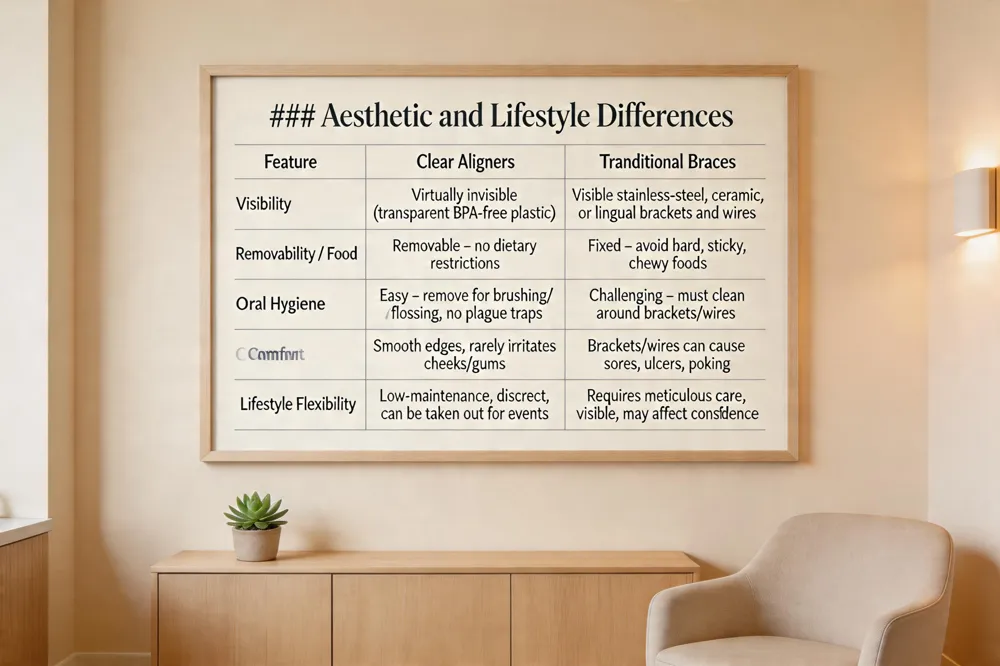 Clear aligners like Invisalign are made from transparent, BPA‑free medical‑grade plastic and are virtually invisible when worn, giving patients a discreet look that many adults and self‑conscious teens prefer. In contrast, traditional metal braces use stainless‑steel brackets and wires that are clearly visible, although ceramic or lingual options can reduce the aesthetic impact.
Because aligners are removable, patients can eat any food without restriction and simply take the trays out for meals, whereas braces require avoidance of hard, sticky, or chewy foods to prevent bracket or wire damage. This removable nature also makes oral‑hygiene simpler: aligners are taken out for brushing and flossing, eliminating plaque‑trapping around brackets and reducing the risk of gum disease. Braces demand meticulous cleaning around wires and brackets, which can be time‑consuming and prone to missed spots.
Comfort-wise, clear aligners have smooth edges that rarely irritate cheeks or gums, while metal brackets and wires can cause sores, ulcers, or poking until the orthodontist adjusts them. Overall, aligners tend to provide a more comfortable, low‑maintenance experience, especially for patients prioritizing aesthetics and lifestyle flexibility.
Treatment Mechanics and Duration
Treatment Mechanics and Duration
| Aspect | Clear Aligners | Traditional Braces |
|---|---|---|
| Force Application | Gentle continuous pressure via custom‑molded SmartTrack™ trays | Intermittent forces from brackets + archwire adjustments |
| Typical Treatment Time | Mild: 6‑12 mo; Moderate: 12‑18 mo; Severe: 18‑24 mo | Mild‑ Moderate: 12‑24 mo; Severe: up to 36 mo |
| Office Visits | Every 8‑12 weeks for progress checks | Every 4‑6 weeks for wire adjustments |
| Planning Technology | 3‑D digital scans (iTero) & virtual treatment simulation | 3‑D scans & bracket placement planning (CBCT, digital models) |
| Patient Involvement | Requires wearing trays 20‑22 hrs/day | Less dependent on patient wear time; force is appliance‑driven |
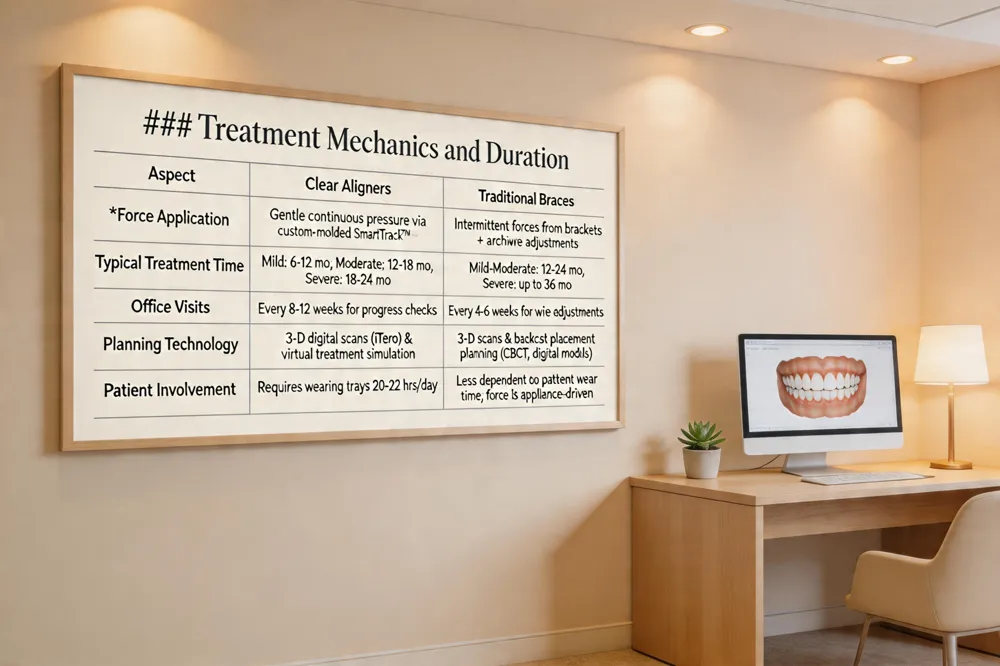 Clear aligners move teeth by applying gentle, continuous pressure through a series of custom‑molded plastic trays that fit snugly over the teeth. Each tray is worn 20–22 hours per day, and the material’s SmartTrack™ technology gently shifts the dentition without brackets or wires. In contrast, traditional braces rely on metal brackets bonded to each tooth and an archwire that is periodically tightened; the wire delivers intermittent forces that can be greater and more precisely directed for complex movements.
Typical timelines differ by case severity. For mild malocclusions, aligners often achieve results in 6–12 months, while moderate cases usually require 12–18 months. Severe or heavily rotated teeth may need 18–24 months with aligners, or longer (up to 36 months) with braces, which excel at severe crowding, large gaps, and major bite corrections.
Office visits reflect the mechanics: aligner patients generally see the orthodontist every 8–12 weeks for progress checks, whereas brace patients require monthly appointments (every 4–6 weeks) for wire adjustments and activations.
Digital planning and 3‑D imaging are central to both modalities. Practices such as V Dental use iTero scans and CBCT imaging to create a virtual treatment plan, allowing clinicians to preview tooth movements, fabricate precise aligners, and map bracket placement for braces. This technology improves accuracy, reduces unexpected adjustments, and helps patients visualize their final smile before treatment begins.
Patient Compliance and Success Factors
Patient Compliance and Success Factors
| Factor | Clear Aligners | Traditional Braces |
|---|---|---|
| Wear Time Requirement | 20‑22 hrs/day (≈ 1‑2 hrs off) | Continuous – no wear requirement |
| 30‑Minute Rule | Re‑insert trays within 30 min after removal | N/A |
| Compliance Impact | Missed hours slow movement, risk relapse | Minimal impact on force delivery |
| Common Dropout Reasons | Difficulty meeting wear time, early discomfort, complex cases | Food restrictions, hygiene challenges, aesthetic concerns |
| Support Strategies | Regular check‑ins, realistic goals, reminders | Frequent adjustments, oral‑hygiene education |
 Clear aligner therapy relies on patients wearing their trays for 20–22 hours per day; missing even a few hours can slow tooth movement. A key guideline is the 30‑minute rule: after removing aligners for meals, non‑water drinks, or oral‑hygiene tasks, the trays should be re‑inserted within 30 minutes. This short window maintains the continuous pressure needed for the planned tooth shift, allows saliva to neutralize eating acids, and prevents enamel erosion or cavities caused by trapped acid. If the rule is ignored, teeth may begin to drift back, extending treatment time and compromising results. Non‑compliance can also lead to delayed progress, higher relapse risk, and the need for additional appointments or supplemental appliances. Many patients quit Invisalign because they struggle to meet the 20–22 hours per day wear requirement, experience early‑stage discomfort, or discover their case is too complex for aligners to handle rotations, large gaps, or severe crowding. Unrealistic expectations, slow visible changes, and the inconvenience of frequent tray changes further erode motivation. Regular check‑ins, realistic goal setting, and supportive guidance from an experienced orthodontist can improve adherence and reduce dropout rates.
Clear Aligners: Pros and Cons
Clear Aligners: Pros and Cons
| Pros | Cons |
|---|---|
| Virtually invisible aesthetic | Limited for severe rotations, large gaps, deep bites |
| Removable – no food restrictions | Requires strict 20‑22 hrs/day wear compliance |
| Easy oral hygiene – remove for brushing | Risk of loss or damage; higher cost for complex cases |
| Smooth, custom‑fit trays reduce soft‑tissue irritation | May need supplemental appliances for difficult movements |
| Ability to see treatment plan via digital simulation | Some patients find frequent tray changes inconvenient |
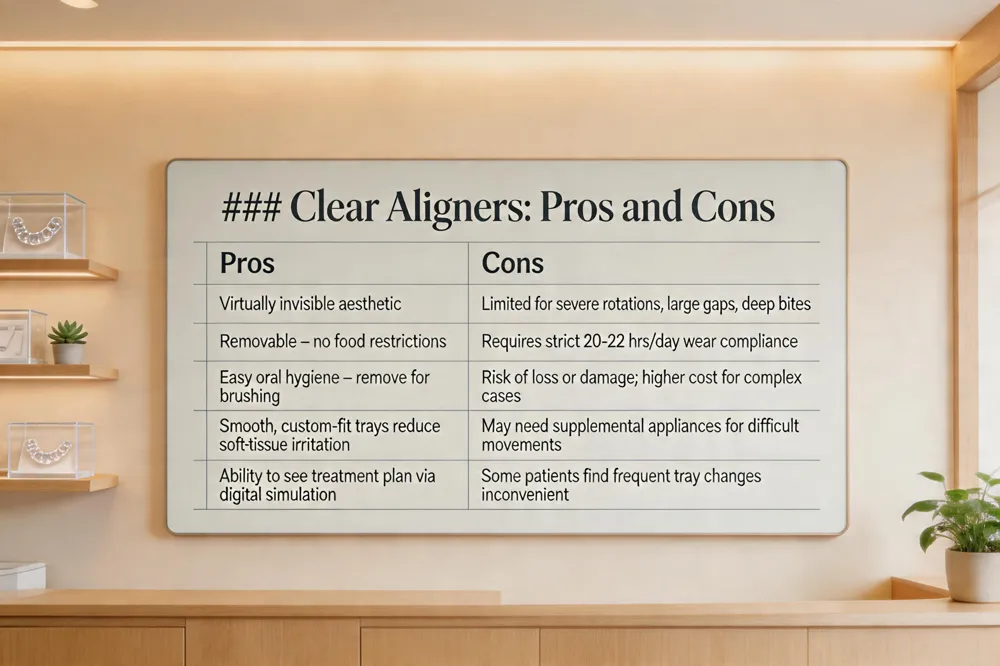 Clear aligners offer a distinct aesthetic advantage because they are made of transparent, BPA‑free medical‑grade plastic and are virtually invisible when worn, allowing patients to straighten teeth without the conspicuous metal brackets of traditional braces. Their removability provides complete dietary freedom; trays are taken out for meals, so there are no restrictions on hard, sticky, or crunchy foods. This same removability simplifies oral hygiene—patients can brush and floss normally without navigating around brackets or wires, which reduces plaque buildup and the risk of gum disease. The smooth, custom‑fit trays cause far less soft‑tissue irritation than metal brackets, making the experience more comfortable and eliminating the need for orthodontic wax. However, clear aligners have limitations for complex movements such as severe rotations, large gaps, or deep bite corrections, where the force they can apply may be insufficient. Success depends heavily on patient compliance; aligners must be worn 20–22 hours per day, and missed wear can stall progress. Additionally, the risk of loss or damage and higher cost for intricate cases are important considerations.
Traditional Braces: Strengths and Limitations
Traditional Braces: Strengths and Limitations
| Strengths | Limitations |
|---|---|
| Excellent for severe crowding, complex bite corrections | Highly visible – may affect confidence |
| Continuous force independent of patient wear | Dietary restrictions (no hard/sticky foods) |
| Can handle large gaps and major rotations efficiently | Oral‑hygiene is challenging; plaque can accumulate |
| Generally lower cost for very complex cases | May cause soft‑tissue irritation, require orthodontic wax |
| Fewer compliance issues – force always applied | Monthly adjustments required, more frequent office visits |
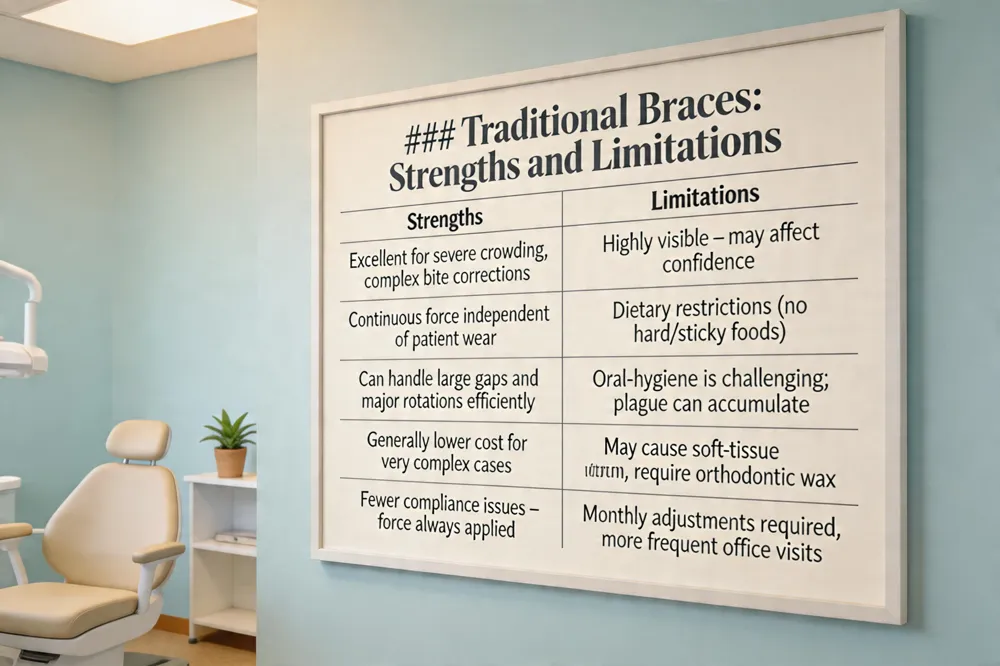 Traditional braces—metal, ceramic, or lingual—excel at treating severe crowding and complex bite problems because they can apply greater, continuous force than clear aligners. This force is delivered by brackets bonded to each tooth and an archwire that is adjusted periodically, so treatment does not depend on patient wear time. For large gaps or major rotations, the constant pressure often closes spaces faster than the intermittent force of removable aligners. The main drawback is visibility: brackets and wires are clearly seen, which can affect confidence, especially in professional or social settings. Braces also impose dietary restrictions; patients must avoid hard, sticky, or crunchy foods that could break or dislodge components. Finally, oral‑hygiene is more challenging because food particles can become trapped around the hardware, increasing the risk of plaque buildup and requiring meticulous brushing and flossing around each bracket and wire.
Cost Comparison and Financing Options
Cost Comparison and Financing Options
| Item | Clear Aligners (Invisalign) | Traditional Metal Braces |
|---|---|---|
| Typical US Price Range | $3,000 – $7,000 | $2,500 – $5,000 |
| Typical Example | $6,000 for moderate‑to‑complex case | $4,200 for similar case |
| Insurance Coverage | Up to $3,000 in many policies (out‑of‑pocket remainder) | Similar coverage limits; often $2,500‑$3,000 |
| Financing Options | Monthly payment plans, FSA/HSA eligibility (e.g., V Dental) | Same financing avenues, often lower monthly payments |
| Additional Costs | Possible extra trays, attachments, refinements | Possible expanders, extra wires, occasional extra visits |
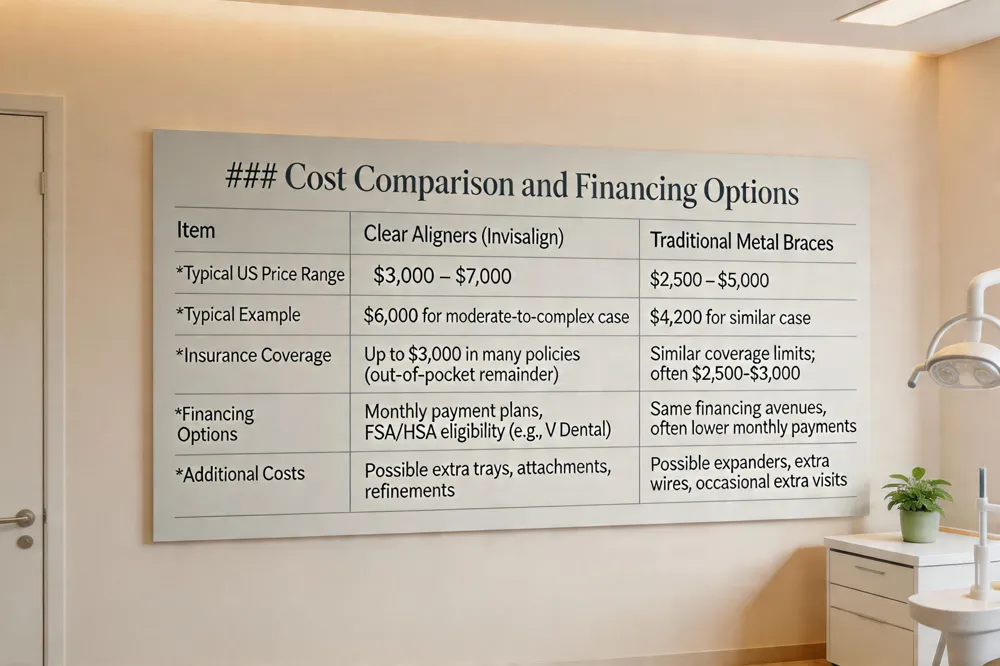 In the United States, the typical price range for Invisalign is $3,000–$7,000, while traditional metal braces generally fall between $2,500 and $5,000. The exact amount depends on several factors: case complexity (severe crowding or large gaps may require extra composite attachments or supplemental braces), overall treatment length, and any ancillary procedures such as expanders or refinements. A $6,000 price tag for Invisalign is entirely normal; it sits comfortably within the national average for moderate‑to‑complex cases where additional trays or longer wear time are needed.
Insurance plans often cover a portion of orthodontic care—up to $3,000 in many policies—so patients typically pay the remaining balance out‑of‑pocket. V Dental in Live Oak, Texas works with most dental insurers and offers flexible financing options, including monthly payment plans and FSA/HSA eligibility, to make both Invisalign and braces affordable.
In summary, Invisalign’s cost is comparable to, with both options ranging from $3,000 to $8,000 depending on individual needs. A $6,000 invoice aligns with national averages, and V Dental’s financing and insurance coordination help patients achieve their desired smile without financial strain.
Frequently Asked Clinical Questions
Frequently Asked Clinical Questions
| Question | Answer |
|---|---|
| Can Invisalign fix an ingrown tooth? | No. Impacted teeth usually need surgical exposure; Invisalign can only fine‑tune after extraction or conventional orthodontics. |
| How many trays are needed for two years of Invisalign? | Roughly 30‑40 trays (2‑3 trays per month) depending on case complexity and refinements. |
| Can I kiss my boyfriend while wearing Invisalign? | Yes. Aligners are smooth and removable; you can keep them in or take them out for intimacy. |
| Are traditional braces or Invisalign more effective? | Both achieve excellent results; braces are more reliable for severe crowding, large bite corrections, and major rotations, while Invisalign excels in mild‑to‑moderate cases with aesthetic and lifestyle advantages. |
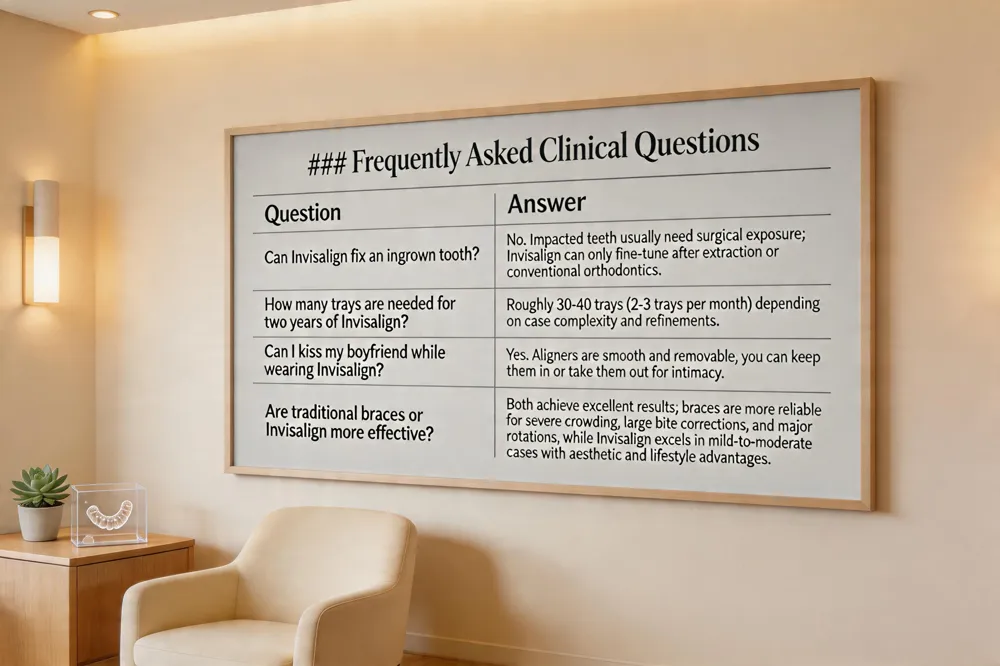 Can Invisalign fix an ingrown tooth?
Invisalign cannot “un‑grow” an impacted tooth. If the tooth is only slightly trapped, a surgeon may expose it and a small attachment or brace‑type component can guide it into place before switching to aligners. Most impacted teeth need surgical exposure or extraction followed by conventional orthodontics, after which Invisalign fine‑tunes the final alignment. An X‑ray or 3‑D scan determines the best sequence.
Can Invisalign fix an ingrown tooth?
Invisalign cannot “un‑grow” an impacted tooth. If the tooth is only slightly trapped, a surgeon may expose it and a small attachment or brace‑type component can guide it into place before switching to aligners. Most impacted teeth need surgical exposure or extraction followed by conventional orthodontics, after which Invisalign fine‑tunes the final alignment. An X‑ray or 3‑D scan determines the best sequence.
How many trays are needed for two years of Invisalign? A typical full‑arch case uses 20‑30 trays for 12‑18 months. Extending to two years generally requires 30‑40 trays, depending on case complexity and any refinements. Trays are changed every 1‑2 weeks, so a two‑year schedule equals roughly 2‑3 trays per month. Your orthodontist can give a personalized count after a digital assessment.
Can I kiss my boyfriend while wearing Invisalign? Yes. The smooth, custom‑fit aligners sit snugly on the teeth and do not interfere with a kiss. Because they are removable, you can take them out for intimacy if desired, but be sure to wear them 20‑22 hours daily overall. Keep the trays clean and maintain good oral hygiene.
Are traditional braces or Invisalign more effective? Both can achieve excellent results, but braces are more reliable for severe crowding, large bite corrections, and major rotations because they provide continuous force and greater control. Invisalign works well for mild to moderate cases, offering near‑invisibility, removability, and easier hygiene, but it requires strict compliance (20‑22 hours/day). Choose based on case complexity, lifestyle, and aesthetic preference.
Putting It All Together – Your Path to a Healthier, More Confident Smile
Clear aligners are virtually invisible, removable, and ideal for mild‑to‑moderate cases, while traditional braces—metal, ceramic or lingual—are fixed, more forceful, and handle severe crowding or complex bite corrections. At V Dental we combine high‑resolution CBCT scans with iTero 3‑D digital impressions to map each patient’s anatomy, then create a customized treatment roadmap and flexible financing options that fit any budget. Ready to discover which solution best fits your lifestyle and goals? Schedule a free consultation today and receive a definitive, personalized orthodontic plan. We’ll also outline retention and maintenance plans.