Understanding the Invisalign Journey
Clear aligners are virtually invisible, removable for meals and oral hygiene, and cause far less discomfort than metal braces. They also reduce emergency visits and allow adults to maintain a professional appearance while straightening teeth. At V Dental in Live Oak, Texas, the journey begins with a 3‑D digital scan using an iTero® intraoral scanner, followed by ClinCheck® software that simulates every tooth movement and lets patients preview their final smile. The customized plan is then turned into a series of SmartTrack™ aligners, each worn 20‑22 hours daily and changed every 1‑2 weeks. Regular check‑ups every 6‑8 weeks keep progress on track, and after the active phase a Vivera™ retainer secures the results for life.
Phase 1 – Consultation, Digital Scanning & Treatment Planning
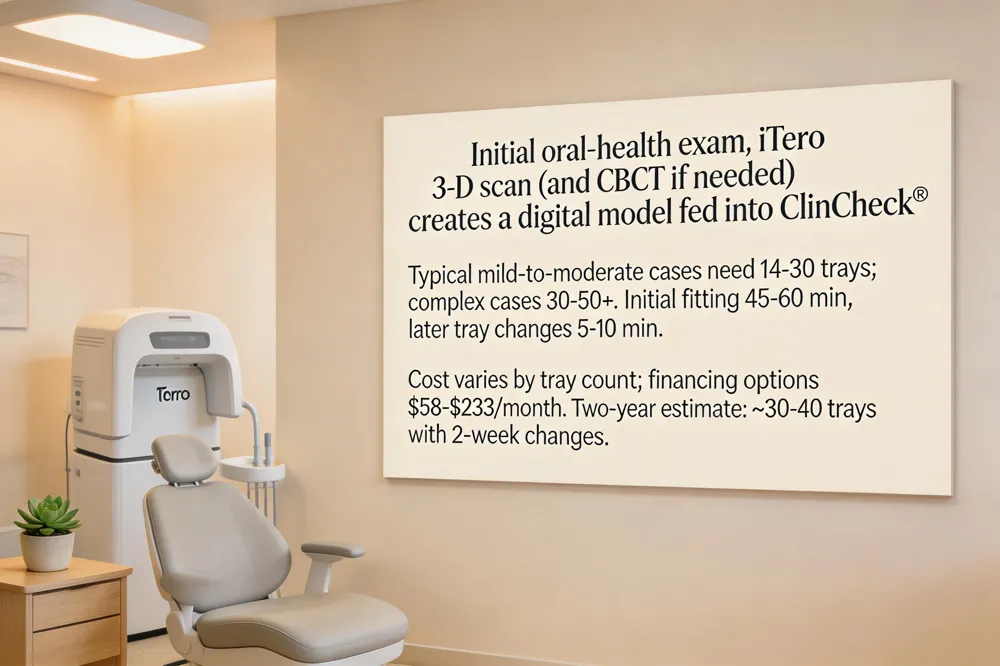 The first step at V Dental is a thorough oral‑health exam to confirm you’re a good candidate for Invisalign. Using an iTero™ 3‑D scanner (and CBCT imaging when needed) we capture a precise digital model of your teeth and bite. That data feeds ClinCheck® software, which simulates each tooth’s movement and predicts the total number of trays required. For most mild‑to‑moderate cases the count falls between 14‑30 trays; a complex case may need 30‑50+ trays, so 47 trays is high but normal for extensive corrections.
How does Invisalign work? Clear SmartTrack™ aligners are fabricated from the ClinCheck plan; each tray moves teeth a fraction of a millimeter while you wear it 20‑22 hours daily.
What are the steps? Book a consultation, get scanned, review the virtual smile, pick up the first aligner, change trays every 1‑2 weeks, attend 6‑8‑week check‑ups, then transition to a custom retainer.
How long does it take to put on? The initial fitting (attachments, scan, first tray) is about 45‑60 minutes; subsequent tray changes take only 5‑10 minutes.
Cost? Pricing depends on tray count and case complexity; V Dental provides a personalized quote, with financing options and typical monthly payments of $58‑$233.
How many trays for two years? Changing every two weeks yields roughly 30‑40 trays; weekly changes would double that.
Phase 2 – Daily Wear, Trayer Changes & Comfort Management
 Patients must keep their aligners in for 20‑22 hours daily, removing them only for meals, water, and oral hygiene. Each tray is typically worn 1‑2 weeks; clinicians may opt for a 7‑day change on simple cases to speed progress, while the 14‑day protocol offers finer control for tougher movements. When a new tray is placed, a mild, dull pressure or soreness—similar to a dental adjustment—appears for 24‑48 hours; this is normal and indicates active tooth movement. Over‑the‑counter pain relievers, soft foods, and inserting the tray before bedtime help manage discomfort. Compliance is the single greatest factor in staying on schedule: missing wear time can extend the 6‑24‑month timeline by weeks or months.
Does Invisalign hurt? Mild pressure is expected and fades quickly; sharp pain or swelling warrants a dentist visit.
Invisalign vs braces Invisalign offers invisible, removable trays for mild‑moderate cases, while braces provide fixed control for severe issues.
1‑week vs 2‑week Both schedules are effective; weekly changes may accelerate simple cases, but the 14‑day protocol is slightly more precise.
Hardest week Most patients find the first week toughest due to initial tightness, which eases after a few days.
Phase 3 – Monitoring Progress, Refinement & Bite Corrections
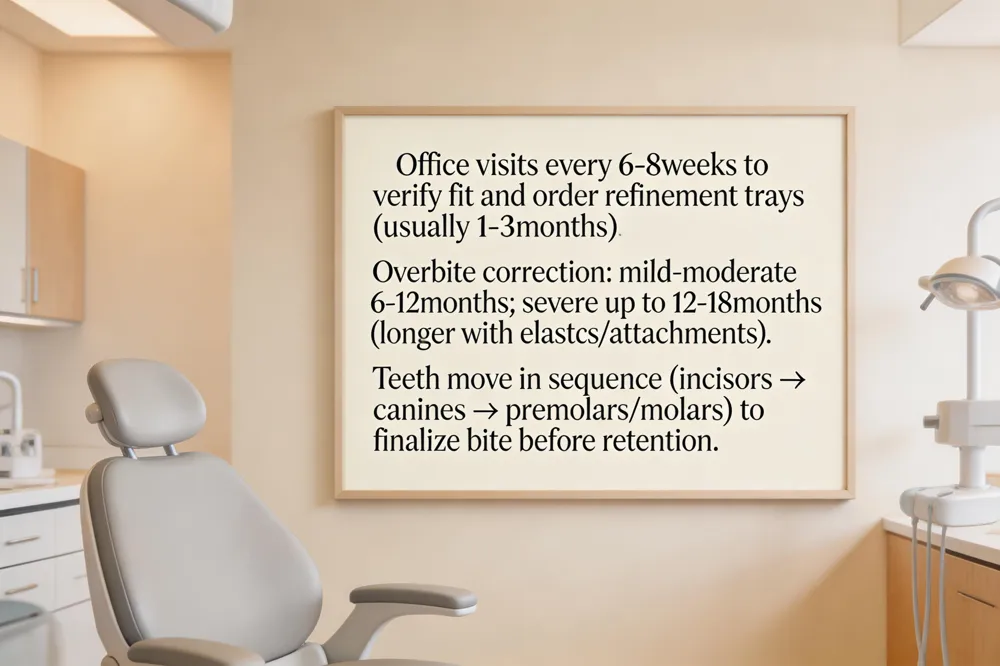 During Phase 3 you visit the office every 6‑8 weeks for a quick check‑up. Dr. Brandon Villarreal reviews the digital scan, confirms that each aligner is fitting correctly, and orders any refinement trays needed. Refinement is the final set of custom aligners—usually 1–3 months long—that fine‑tune any remaining gaps, rotations, or bite issues after the original series ends. Overbite correction follows the same principle: mild to moderate overbites typically wrap up in 6–12 months, while more severe cases may require 12‑18 months (or longer if elastics or attachments are used). The treatment sequence is staged; the front incisors move first to create space, followed by canines, then premolars and molars, which finalize the bite and provide stability. Consistent wear of 20‑22 hours a day and attending all scheduled appointments keep the timeline on track and ensure a stable, aesthetically pleasing result before moving to the retention phase.
Phase 4 – Retention, Long‑Term Stability & Visual Results
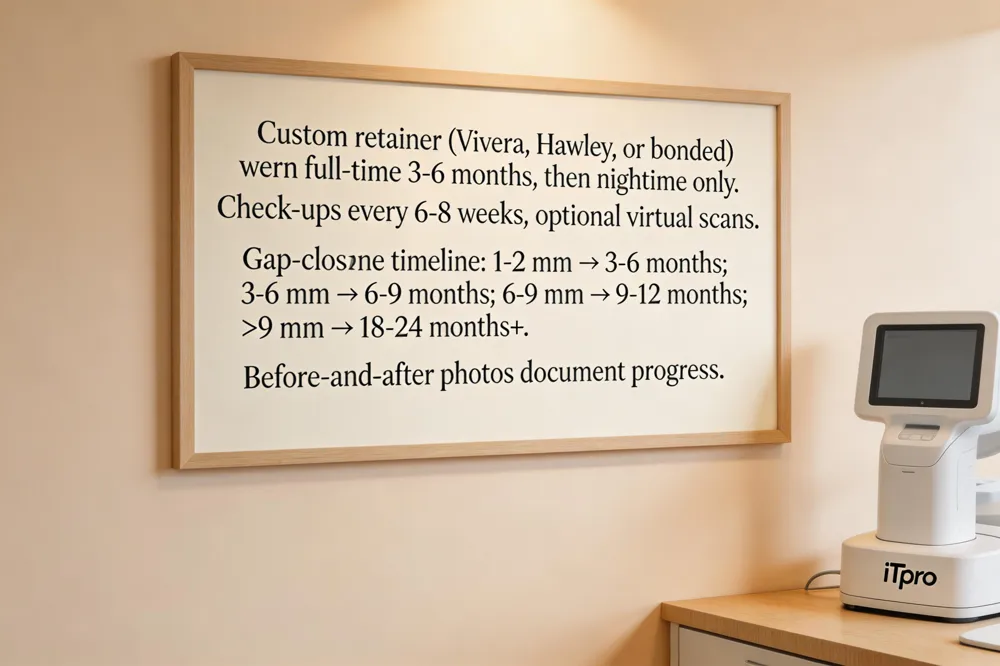 After the active aligner phase, V Dental fits each patient with a custom retainer—options include removable clear Vivera trays, traditional Hawley appliances, or permanently bonded wire retainers. The protocol starts with full‑time wear (20‑22 hours daily) for the first 3‑6 months, then transitions to nighttime‑only wear to lock in the new tooth positions. Ongoing monitoring includes scheduled check‑ups every 6‑8 weeks and optional virtual scans, ensuring the retention phase proceeds without relapse. Before‑and‑after photography captured with iTero 3D scans documents the transformation, providing a visual record of alignment, gap closure, and bite improvement.
How long does Invisalign take for gaps? Small 1‑2 mm gaps close in 3‑6 months; moderate 3‑6 mm gaps need 6‑9 months; larger 6‑9 mm gaps take 9‑12 months; very wide spaces over 9 mm may require 18‑24 months or more. Consistent 20‑22 hour wear is essential.
Invisalign before and after – V Dental’s gallery shows dramatic smile changes, often visible within 3‑6 months and fully resolved in up to a year for complex cases, thanks to precise digital planning and removable aligners.
Invisalign process pictures – The practice’s online gallery walks patients through the iTero scan, aligner placement, monthly progress shots, and the final result.
Invisalign video for patients – A short video explains the scan, custom aligner fitting, wear schedule, cleaning tips, and remote monitoring options, ending with a call to schedule a follow‑up at the Live Oak office.
Financial Considerations & Frequently Asked Price Questions
 The typical Invisalign price in the United States falls between $1,500 for very mild cases and $8,000 + for extensive work, with most patients paying around $5,000‑$6,000 before insurance. Dental plans often cover 50‑80 % of the fee, reducing out‑of‑pocket costs to $2,500‑$3,500 for many adults. V Dental in Live Oak, Texas creates a personalized quote after a 3‑D iTero scan and offers flexible financing—monthly plans from $58 to $233, CareCredit, and interest‑free options—to make the expense manageable. The investment reflects advanced digital imaging, SmartTrack™ aligners, and custom attachments that improve predictability and comfort.
Is $6,000 normal for Invisalign? Yes, it sits within the national range and reflects case complexity and technology used at V Dental.
Is $5,000 a lot for Invisalign? No; $5,000 is average for moderate to severe cases and often reduced by insurance and financing.
Invisalign cost – Determined by aligner count, treatment length, and case difficulty; V Dental provides a tailored estimate and payment plans to fit each budget.
Start Your Smile Transformation Today
Take the first step toward a confident smile by scheduling a personalized consultation at V Dental in Live Oak, Texas. During this visit Dr. Brandon Villarreal will evaluate your oral health, capture a 3‑D digital scan with an iTero scanner, and design a custom Invisalign treatment plan that shows a preview of your expected results. V Dental offers flexible financing options—including interest‑free payment plans, HSA/FSA benefits, and coordination with most dental insurance—to make the cost of clear aligners affordable. With modern technology such as CBCT imaging, digital X‑rays, and SmartTrack™ aligners, you’ll experience discreet, comfortable orthodontic care that fits your lifestyle. Start your transformation today and let V Dental bring your smile vision to life and a lasting confidence.